whatsWhat types of machine tools are there?
What types of machine tools are there?
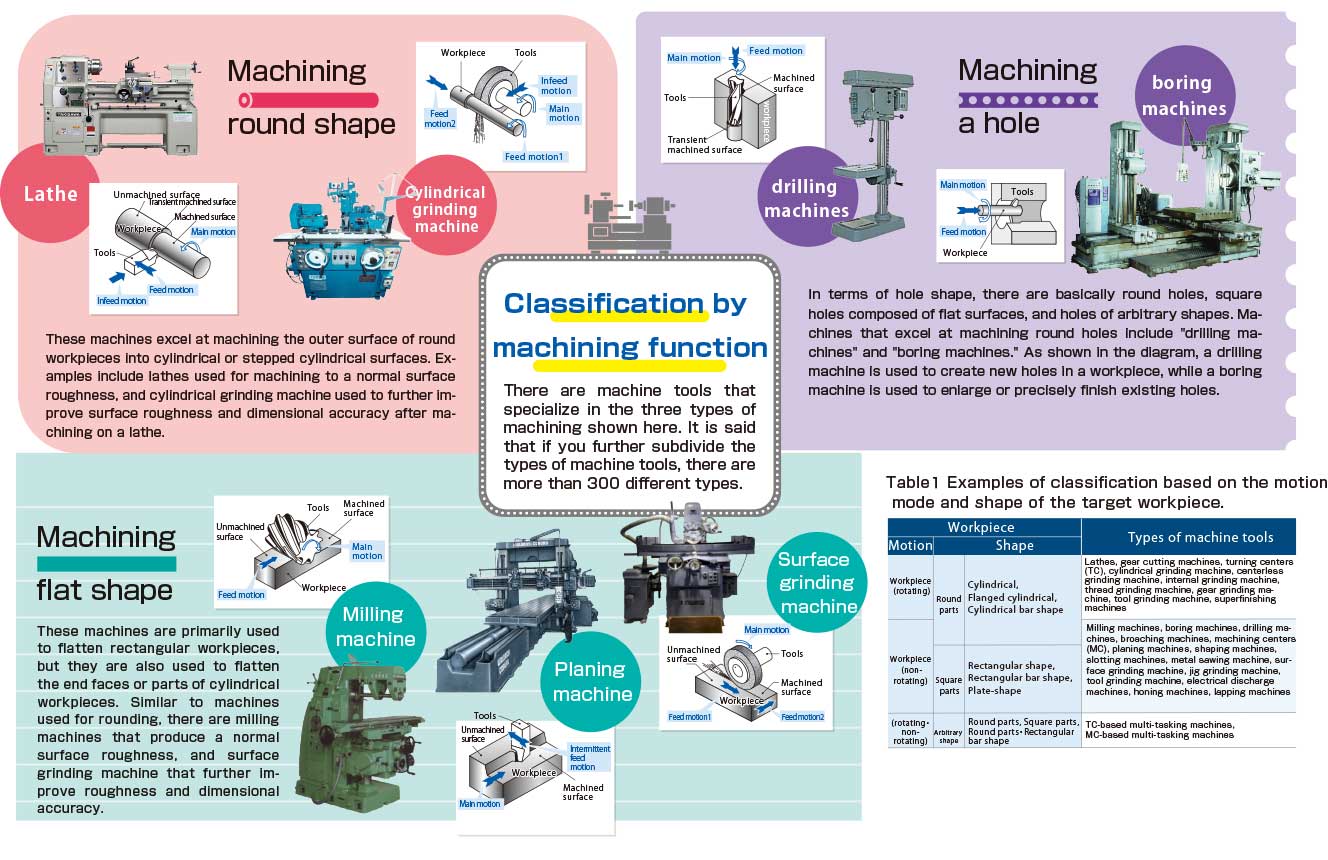
The basic types are "machines for rounding, flattening, and machining hole."
Rough types of machine tools
Although the shapes of machine parts may appear complex at first glance, both their outer and inner surfaces are fundamentally based on "cylindrical surfaces" and "flat surfaces," and are further composed of combinations of "specific shaped surfaces" such as screw surfaces and gear tooth surfaces, and "arbitrary shaped surfaces" such as free-form surfaces, as needed. Therefore, there are machine tools that excel at machining these surfaces, and they are classified as follows.
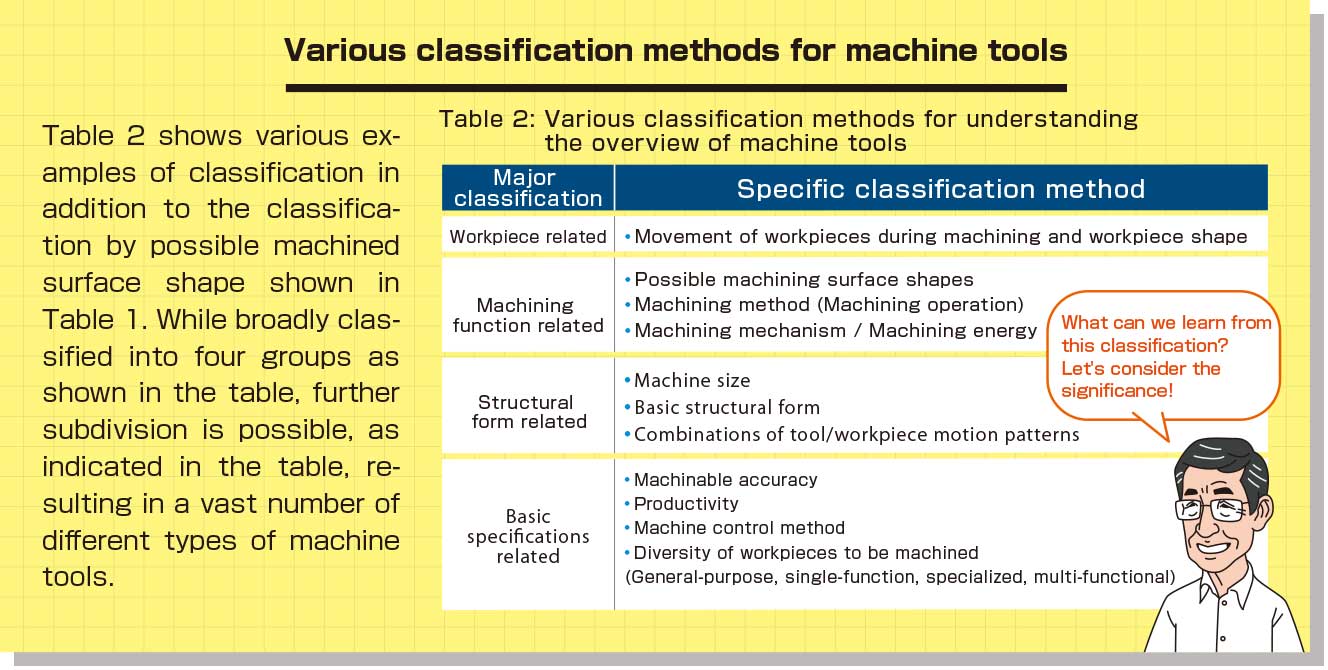
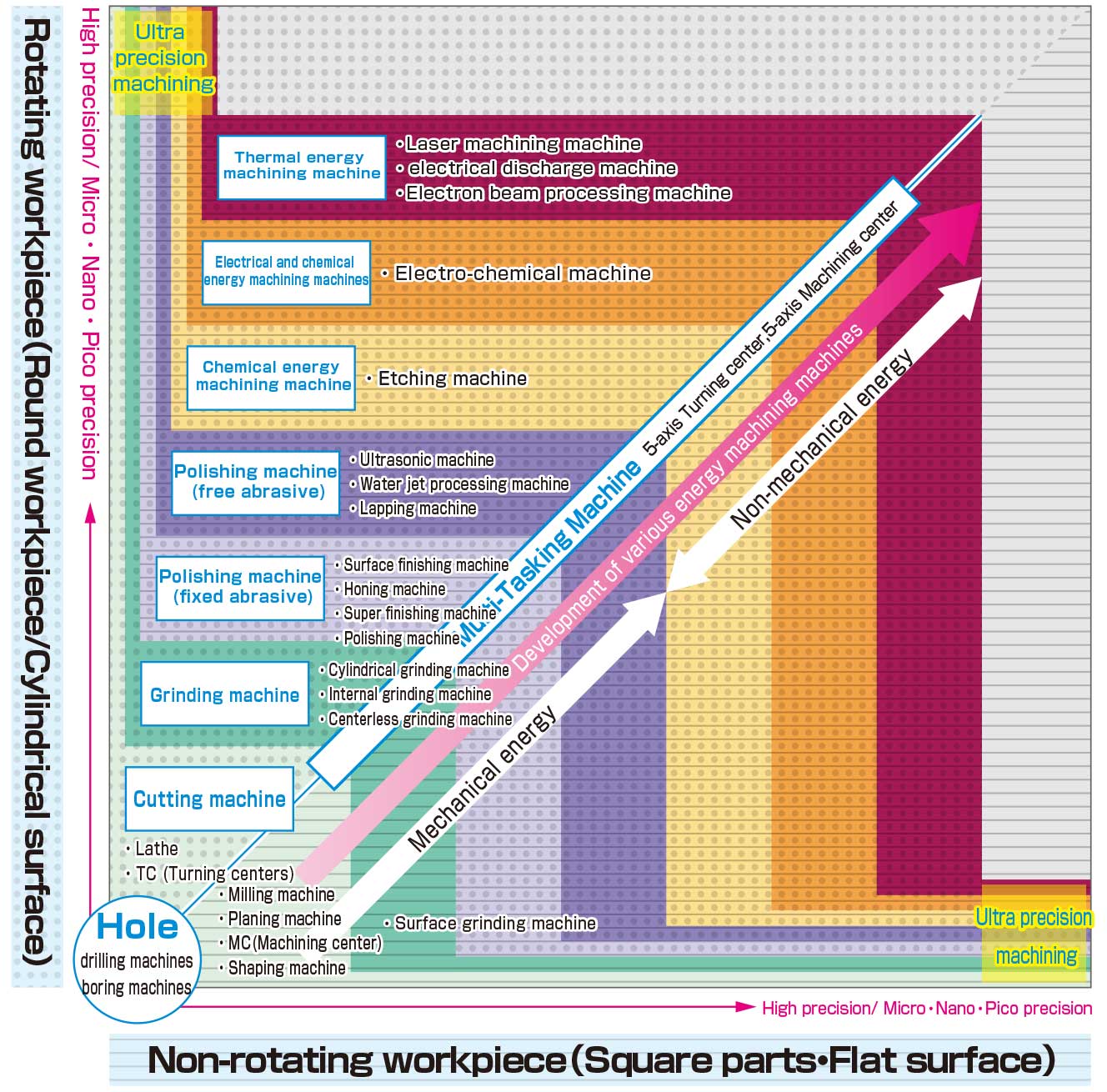
Examples of complex classifications of machine tools
The diagram on the left shows an example of a complex classification of machine tools based on the energy used for machining, the machining mechanism, and the machined shape. The energy used for machining includes mechanical energy, chemical energy, electrochemical energy, and thermal energy. Mechanical energy includes the machining that utilize mechanical energy, such as cutting, grinding, polishing, jetting, and ultrasonic machining. Chemical energy machining includes etching, which applies chemical reactions; electrochemical energy machining includes electro-chemical machining, which applies electrolytic action; and thermal energy machining includes laser, electrical discharge, electron beam, and plasma machining, which apply melting and vaporization. The diagram further classifies machines into those that machine surfaces rounded and those that machine surfaces flat. Furthermore, there are machine tools that can handle various machined surface shapes and multiple machining energies; these are called composite machine tools.
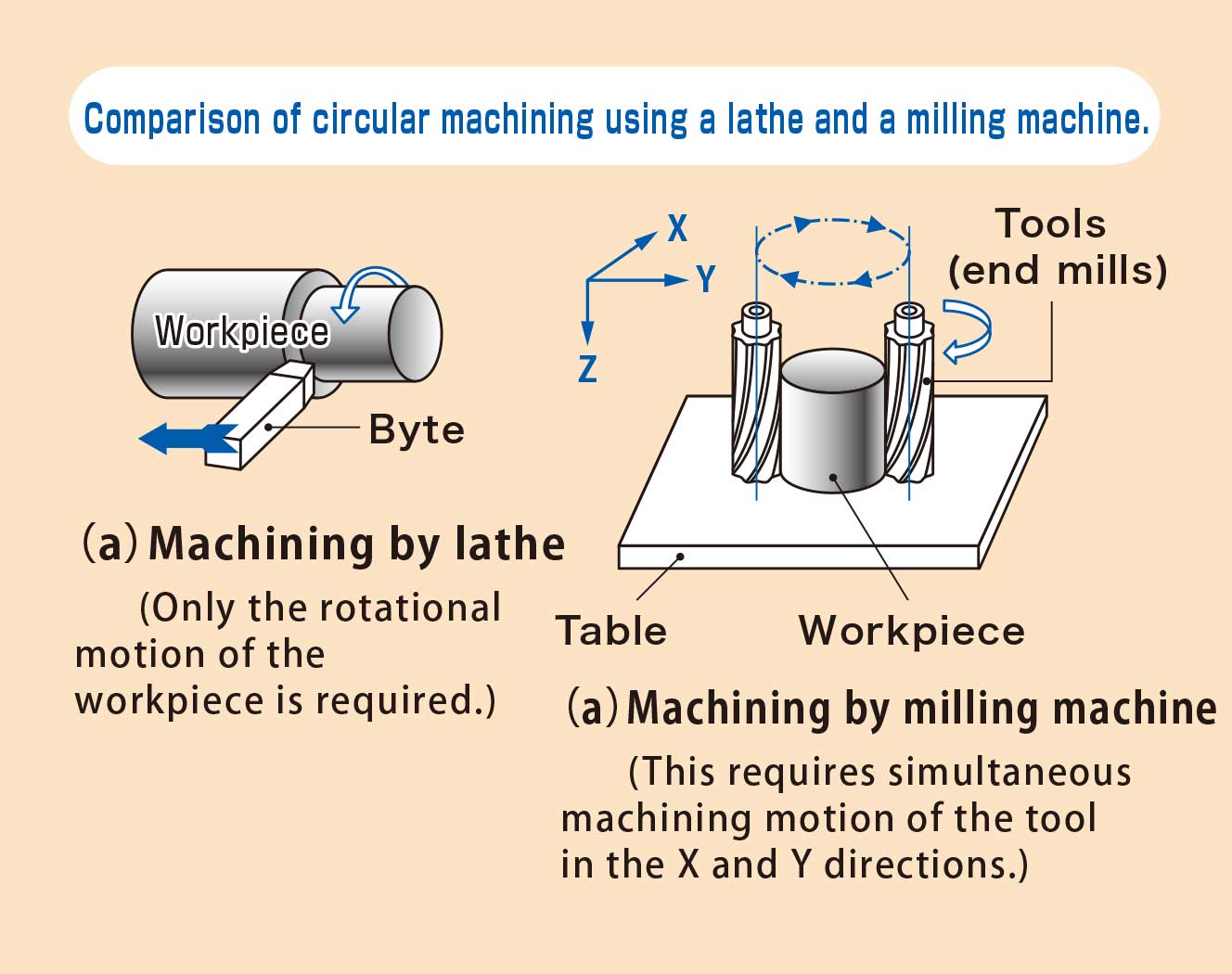
It seems easier to machine a round shape by stopping the tool and rotating the workpiece than by stopping the workpiece and moving the tool in a circular motion, right? That's why many machines that machine round shapes rotate the workpiece.